How Strada reduced traffic through central servers by 90.7% with iroh
by Rae McKelvey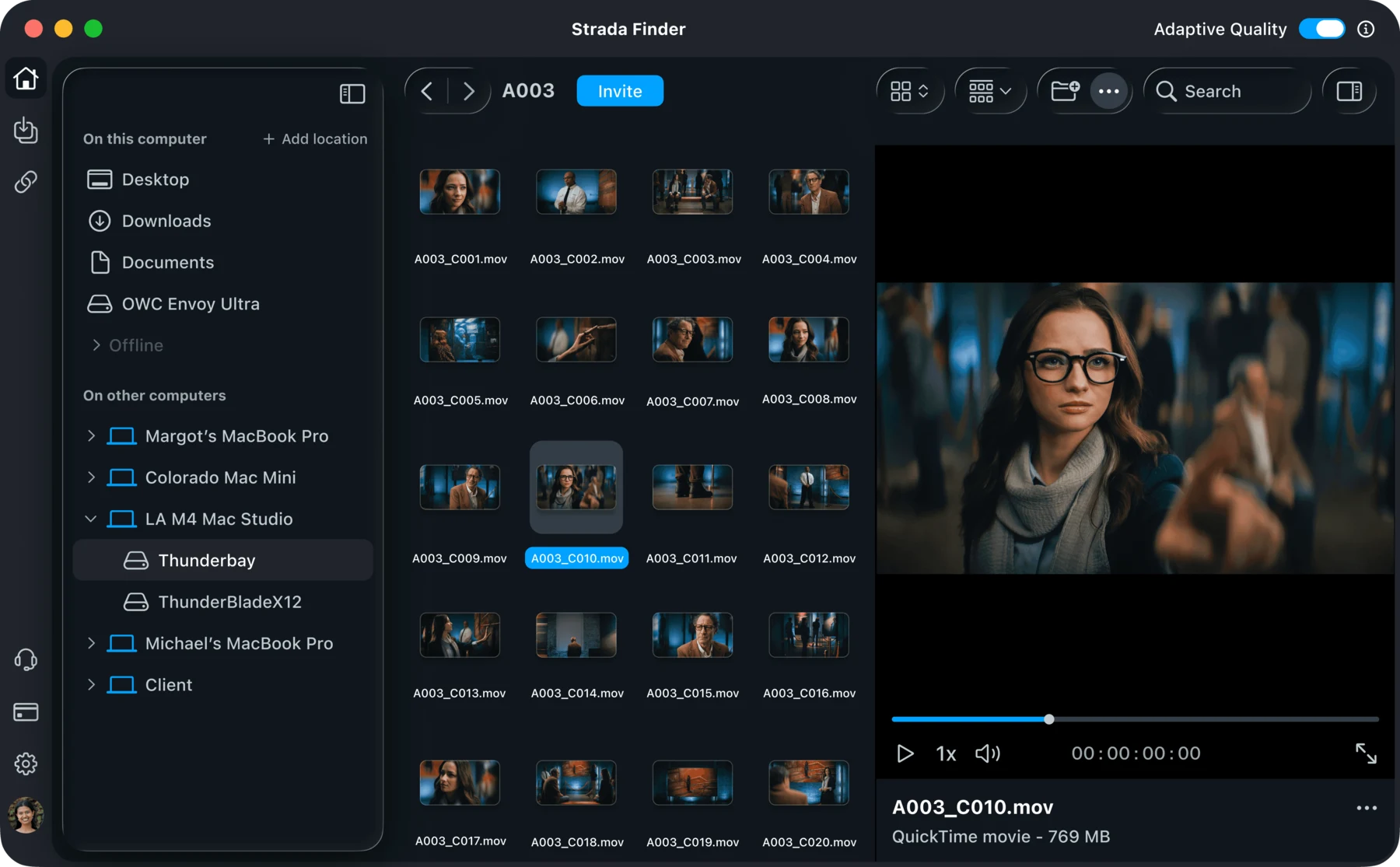
In a client-server architecture, the path is familiar: a computer uploads a file to a data center, and then gets sent around the world again to the other computer that needs it. This happens sometimes even if the devices are in the same room. It's a ridiculously inefficient use of data centers, and it's also costly for organizations that have to pay for that unnecessary egress.
Strada is changing this by using iroh. Strada helps creative teams access and edit media stored on remote drives. Strada's app allows files to move directly between devices instead of uploading files to the cloud unnecessarily. In Strada's July 2026 production workload, 150 TB would have crossed centralized infrastructure if every byte had gone through central servers. 13.9 TB actually did—a 90.7% reduction.
Centralized services still make sense for the parts of a product that benefit from them. The important change is that central infrastructure no longer has to sit in the data path for most large file transfers.
Why media workflows are a great use case for peer to peer
Media professionals need to access information on multiple drives, which could be local or remote. It's a much quicker workflow to mount remote storage as a virtual drive, so you can browse, preview, and work with files without uploading or downloading.
Put the shortest reliable path in the data plane
Iroh establishes an end-to-end encrypted connection between the two devices. It tries the direct path first, including across NATs and firewalls. When network conditions prevent that path, a relay forwards the end-to-end encrypted traffic so the transfer can continue. Relays cannot read or store the file data, and Strada runs discovery under its own domain.
This separation also lets each layer do a clearer job:
- The endpoints hold and exchange the large media files.
- Iroh finds and maintains an encrypted path between those endpoints.
- Relays preserve connectivity when a direct path is unavailable, without reading or storing file data.
It is a more deliberate use of the cloud: keep it for coordination and services that need centralization, rather than paying it to carry every byte between devices.
150 TB through central servers, compared with 13.9 TB in practice
The change in traffic crossing Strada’s centralized infrastructure is substantial. To put its potential cost impact in context, the estimates use standard US-region internet data-transfer rates of about $0.09/GB as a benchmark:
| Metric | If every byte crossed central servers | What actually crossed central servers | Difference |
|---|---|---|---|
| Monthly traffic | 150 TB | 13.9 TB | −136.1 TB (−90.7%) |
| Estimated monthly egress cost | $11,571.20 | $1,261.06 | −$10,310.14 |
| Annualized estimated cost | $138,854.40 | $15,132.72 | −$123,721.68 |
That is 136.1 TB less traffic through centralized infrastructure each month. At the AWS benchmark rates, that reduction would be worth about $10,310 per month, or $123,700 annualized. These figures illustrate the economics of the traffic reduction; they are not a statement about Strada’s cloud provider or its actual bill.
A better scaling model for large-file products
Strada shows why architecture matters to a product’s unit economics. Under a centralized model, successful adoption creates a nearly linear increase in egress: every additional file transferred adds another full file to the cloud bill. With a direct-first model, much of that traffic stays between the devices already sending and receiving it.
The same pattern applies beyond professional media. Backup, synchronization, remote access, dataset distribution, and other data-heavy products all benefit when central infrastructure coordinates movement without automatically carrying the payload.
For Strada, putting iroh in the data plane meant preserving reliable access to remote media while removing centralized infrastructure from the path of most file data. Creative teams keep moving the files they need; Strada carries dramatically less traffic through centralized infrastructure.
Visit Strada or read more about how iroh connects devices directly.
The AWS pricing benchmark assumes 1 TB equals 1,024 GB and applies rates of $0.09/GB for the first 10 TB, $0.085/GB for the next 40 TB, and $0.07/GB for the next 100 TB. It excludes taxes, negotiated discounts, credits, and the 100 GB monthly free allowance. It is not Strada’s actual bill and does not imply that Strada uses AWS. The more durable result is the traffic reduction itself: only 9.3% of the volume in the central-server scenario actually crossed centralized infrastructure.
To get started, take a look at our docs, dive directly into the code, or chat with us in our discord channel.